
Seven Gunmen and a Car Bomb: The Godka Jilacow Attack, August 2014
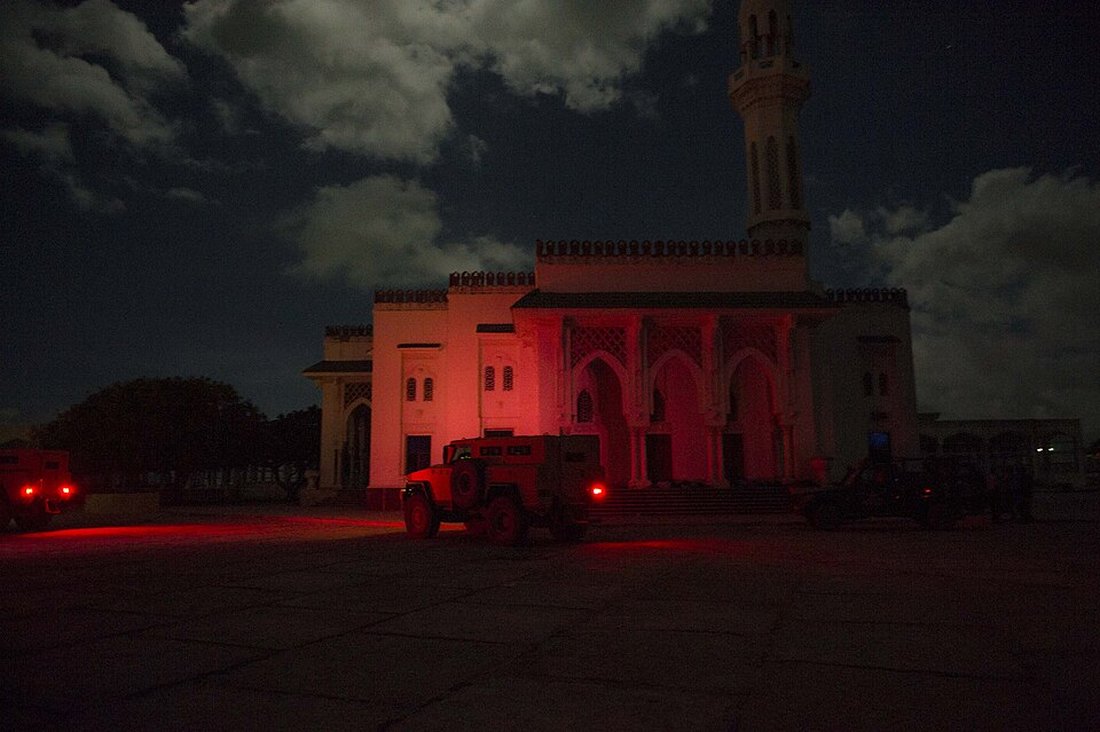
A car bomb went off at the gate of Godka Jilacow on 31 August 2014, and seven men with guns went in behind it. The building belongs to the National Intelligence and Security Agency, the one institution in Somalia whose whole job is to know what is coming. The attack came a day after government and African Union troops took Bulo Marer. I do not know whether the timing was luck. I think it was planning, and I think the people who planned it had read the government’s calendar better than the government had read theirs.
On Sunday 31 August 2014 a suicide car bomb went off at the main gate of Godka Jilacow, the detention centre run by Somalia’s National Intelligence and Security Agency in the Hamar Jajab district of Mogadishu, and seven armed men tried to storm in behind it. Police said at the time that the aim was to free “terrorists” held inside. Al-Shabaab claimed the attack and, in Al Jazeera’s account, said its fighters had entered the building. The accounts of how far the attackers got do not agree. The Associated Press wrote that gunmen “fought their way into the prison” and threw grenades to penetrate its defences. The US State Department’s Country Reports on Terrorism for 2014 says that the agency’s officers “reportedly killed all the attackers, preventing them from breaching the interior of the facility.” CNN’s Japanese service reported that the attackers wore government uniforms, which is the detail that would come back eleven years later at the same gate.
The attack came at a particular moment. The Associated Press noted that it shattered a period of calm in the capital and that it came a day after government and African Union troops seized the town of Bulo Marer, about 110 kilometres south of Mogadishu, as part of an offensive the officials called “Indian Ocean” against Al-Shabaab’s last major centres. Information Minister Mustafa Duhulow said the attack was meant to make the world believe Mogadishu was not safe. Whatever the group meant by it, a prison is a place where an armed movement can be sure that its own people are held, and the offensive was taking more of them.
The casualty figures differ by exactly one civilian. Mohamed Yusuf Osman, then spokesman for the Ministry of National Security, told VOA that seven attackers, three guards and one civilian were killed, eleven dead in all. The Associated Press, quoting Information Minister Mustafa Duhulow, reported seven attackers, three guards and two civilians, twelve dead. CNN Japan, citing an unnamed security official for the same toll, added fifteen wounded. Al Jazeera’s early report said only that at least seven attackers had been killed. I treat eleven or twelve as the range and I would not claim to know which is right.
What none of these reports contains is a single fact about the people the attackers came for. VOA wrote that witnesses saw no prisoners escape. The Associated Press wrote that many suspected militants are believed to be held in underground cells there, and a senior police officer, Ahmed Hussein, told Somali media that the facility included underground cells. Beyond that I found no report that says how many detainees were held, who they were, whether any were hurt when a bomb detonated at the gate and a gun battle followed, or what happened to them afterwards. The attack was reported as an event in the war between the government and Al-Shabaab. The detainees, who were the stated reason for it, drop out of the story in the first paragraph.
That omission is the argument of this piece. The building has always been described in terms of what it is for: an intelligence agency’s interrogation centre. OPR has written separately about allegations that it kept operating after its official closure, in our earlier assessment of Godka Jilacow. If the detainees inside a facility such as this one cannot be counted when the facility is attacked, they cannot be counted in peacetime either, and an attack that kills a dozen people leaves no one with a duty to say who else was in the line of fire.
The shape of the attack matters too. A vehicle bomb to open the gate, then gunmen on foot in borrowed uniforms, is not an improvised raid. It is a sequence, and Al-Shabaab used it again at the same gate in October 2025, when seven attackers drove through seven checkpoints in a vehicle disguised as an agency car. The defence against a bomb at a gate is not another guard at the gate. In 2014 and in 2025 the public account ended the same way, with the attackers dead and officials saying prisoners had not escaped. Neither account was followed, as far as I can find, by a published inquiry into how the gate fell.
I do not know why the 2014 attack failed to free anyone, if it did. Witness accounts are not a prison register. I would like to hear from anyone who was held at Godka Jilacow on that day, or whose relative was, or who served there. OPR will treat what you tell us as confidential. The attack is entered in OPR’s register of Al-Shabaab attacks on prisons, which also corrects a date that earlier versions of the register had wrong: the attack was on 31 August, not 21 August.
Godka Jilacow is the intelligence agency’s own building, and this is the part of the series where the agency has to be named. A suicide car bomb at the main gate, then seven men on foot in government uniforms, in the capital, at the facility of the organisation whose purpose is to know in advance. The state’s account was that its officers killed all the attackers and prevented a breach. Perhaps so. But an agency that learns of a plan on the day of the attack has done the wrong half of its job, and I found no public sign that it had learned anything earlier. The attack came the day after the government seized Bulo Marer, which suggests the attackers knew the government’s calendar well enough to time a strike on its most sensitive prison. I read that as counterintelligence, and on the evidence in this part and the three before it, Al-Shabaab’s was better. Nor did the state say who was in the cells. The detainees who were the attackers’ reason for coming dropped out of every official account.
So I will ask the agency directly. How many people were held at Godka Jilacow on 31 August 2014, and who were they? Were any hurt when a bomb went off at the gate and a gun battle followed? How did seven armed men reach the capital’s most sensitive prison on the day after a major offensive, and who knew? And if the agency’s officers really did kill every attacker, why has it never said what it learned about who sent them?
This is Part 4 of 15 in OPR’s series on Al-Shabaab’s attacks on prisons, one piece for each attack. It follows Part 1, on the capture of Jowhar and its prison in 2009; Part 2, on the twenty suspected militants who walked out of Baidoa prison in 2012; and Part 3, on the attack on Bosaso Central Prison in 2013. Part 5, on the attack on Beledweyne prison in 2015, will be published on Monday 7 December 2026. Every attack, with the figures each source gave, is in the register of Al-Shabaab attacks on prisons.
Sources
VOA News, “11 Killed as Militants Attack Prison in Somalia”, 31 August 2014, quoting Ministry of National Security spokesman Mohamed Yusuf Osman
Associated Press, “Somalia: 12 killed as army repels attack on prison”, 31 August 2014, via Ahram Online (Information Minister Mustafa Duhulow; police Captain Mohamed Hussein)
US State Department, Country Reports on Terrorism 2014, Africa Overview
Somalia Media Monitoring, Daily Monitoring Report, 1 September 2014 (senior police officer Ahmed Hussein)
Al Jazeera, 31 August 2014; CNN Japan (cnn.co.jp), 31 August 2014

How to cite this piece
Abukar, Ismail, for the Organization for Prisoners' Rights. (2026). Seven Gunmen and a Car Bomb: The Godka Jilacow Attack, August 2014. Mogadishu: OPR. https://opr.org.so/news/godka-jilacow-attack-31-august-2014/