The Vaults of Impunity: Detention Without Oversight, 2020–2026
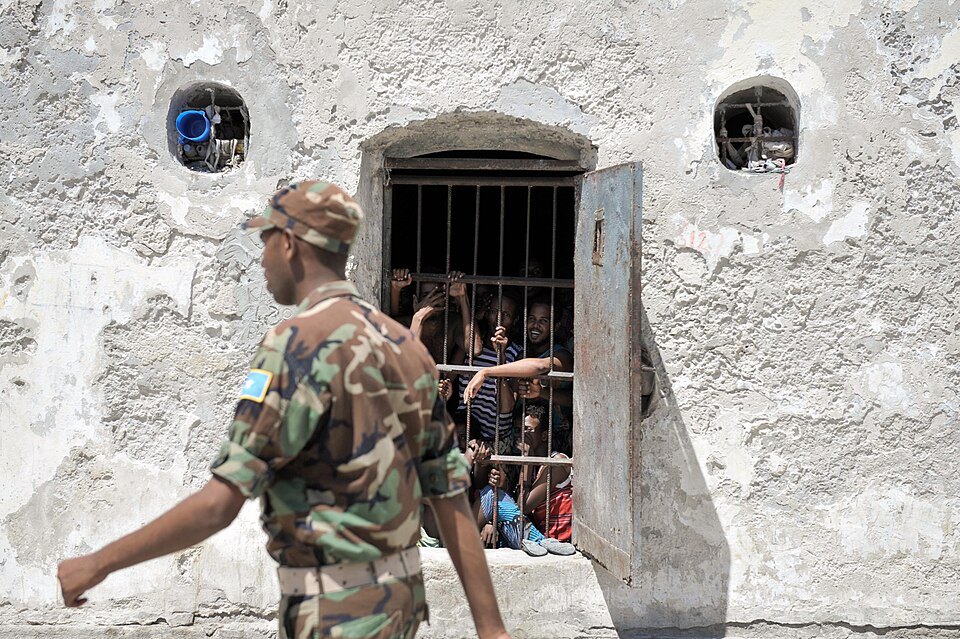
- Solitary confinement and detention without judicial review are entrenched practices in Somalia and Somaliland, and reform announcements from both administrations have not opened the most secretive sites to independent inspection.
- The 2023 intelligence law kept a 48-hour rule but allowed warrantless arrests in undefined “emergency situations”. Human Rights Watch says NISA seldom brings detainees before a magistrate within 48 hours.
- In 2026, journalist Mascuud Warsame was held by the National Intelligence and Security Agency (NISA) for 38 to 39 days without charge or a judge, at the facility known as Godka Jilacow 2, and was allowed to speak to his wife only twice.
- Somaliland has pardoned hundreds of prisoners convicted of minor offences, while prisoners from the Las Anod war were, as of July 2026, still held pending a political deal.
- I did not seek comment from NISA, the Federal Ministry of Justice or Somaliland’s prison command before publication. Any responses received will be added as an update.
The United Nations Standard Minimum Rules for the Treatment of Prisoners, the Nelson Mandela Rules, define solitary confinement as confinement for 22 hours or more a day without meaningful human contact, and prolonged solitary confinement as anything beyond 15 consecutive days. They allow it only in exceptional cases, as a last resort, for as short a time as possible and subject to independent review, and they prohibit it for prisoners with disabilities when it would worsen their condition. A UN expert has said that prolonged solitary confinement beyond 15 days is regarded as a form of torture.
Somalia is a party to the Convention against Torture and the International Covenant on Civil and Political Rights. Its provisional constitution requires that an arrested person be brought before a judicial authority within 48 hours. Article 11 of the Covenant states that no one shall be imprisoned merely for inability to fulfil a contractual obligation.
The domestic law does not match this standard. As I read Somalia’s Prison Law and the regulation governing the Custodial Corps (the national prison service), neither bars solitary confinement. They treat it as an ordinary disciplinary measure, with no statutory maximum and no judicial review, which leaves prison wardens wide discretion. My review of court and municipal practice in both territories also found people held for unpaid private debts, which Article 11 forbids.
In February 2023, Somalia’s Senate passed a bill giving the National Intelligence and Security Agency (NISA) powers of arrest, detention and surveillance. Human Rights Watch warned that it gave the agency sweeping powers with minimal independent oversight. Its specific concerns were that the bill allowed arrest without a warrant in undefined “emergency situations”, gave detainees access to a lawyer and family only after 48 hours, and, while banning “secret prisons”, allowed the agency to run detention facilities without specifying where. Human Rights Watch also said NISA already seldom met the existing 48-hour requirement.
The U.S. State Department’s 2023 report says the law required warrants except where a suspect was caught in the act, prompt notification of charges, access to a lawyer and family, and judicial review. It concludes that adherence to these safeguards was rare.
The problem is therefore not only what the law permits. It is that the safeguards it contains are not applied, and that “emergency” and “national security” exceptions are wide enough to cover most cases.
The pandemic arrived in overcrowded prisons. On March 22, the commander of the Custodial Corps, General Mahad Abdirahman Adan, announced a ban on all external visits to correctional facilities, following a Ministry of Health mandate. It was presented as a two-week halt and was repeatedly extended. The International Committee of the Red Cross (ICRC), which reported in April that some facilities had halted family visits, arranged telephone contact for prisoners. I have not found an official announcement of when the ban ended, but by August officials were describing visits as taking place twice a week. On August 10, an armed attack inside the prison killed 19 people, after weapons were smuggled in two days earlier. I set out the details in When the Virus Reached the Cells.
Health funding was under strain at the same time. In August 2020, a Banadir Regional Court in Mogadishu sentenced four Ministry of Health officials, including Director-General Abdullahi Hashi Ali and Director of Administration and Finance Mohamud Bule, to prison terms ranging from three to eighteen years for corruption, theft of public funds, and falsifying documents related to the pandemic response. Investigative reporting by the Global Initiative Against Transnational Organized Crime documented diverted donor aid and protective equipment turning up on pharmacy shelves in Mogadishu. A later audit found that the government had mobilised $51 million for the COVID-19 response but used only $15 million.
Somaliland pardoned 574 low-risk prisoners on April 1 but left journalist Abdimalik Oldon in prison.
In 2021, Somalia’s delayed elections and the extension of President Farmaajo’s mandate produced a political crisis. Fahad Yasin headed NISA from August 2019 until September 2021, and in this period I documented the abduction of opponents of the extension, journalists and civil society organisers, who were held in NISA cells.
On June 26, NISA employee Ikran Tahlil Farah disappeared in Mogadishu. Accounts of what happened conflict: NISA said she was killed by al-Shabaab, which denied it. One account holds that she had sensitive information about the deployment of young Somali recruits to Eritrea. Women’s rights organisations still cite her case as an emblem of enforced disappearance without an independent investigation. OPR’s report, Who Silenced Ikran?, sets out the contested accounts.
In March, al-Shabaab attacked Bosaso Central Prison and claimed to have freed more than 400 prisoners, and Somaliland suspended all visits in its fourteen prisons. See A Second Year Behind Closed Doors.
Hassan Sheikh Mohamud returned to the presidency in May 2022 with promises of intelligence reform, and Mahad Salad became NISA director in August. Reform announcements were not new. In December 2018, the government said it would convert Godka Jilacow into a training facility for intelligence officers. Reports of its continued use as a prison followed, and in October 2025 al-Shabaab attacked it as a NISA prison. In my assessment, promises to close or repurpose secret detention sites have moved personnel and locations rather than ended isolation.
In Somaliland, the administration intensified its use of detention against opponents ahead of delayed elections. By late 2022, tensions in the Sool region led to a security crackdown, and I documented cases of local elders and youth organisers being rounded up and transferred to high-security cells in western Somaliland, far from home. That separated detainees from clan-based legal protections and from familiar lawyers.
Fighting broke out in Las Anod in February between Somaliland forces and SSC-Khatumo, a local administration aligned with Somalia’s federal government. The intelligence law was signed in March. After the fighting, the ICRC visited more than 300 Somaliland detainees held in Las Anod and facilitated the transfer of wounded prisoners to hospital for specialized treatment, and had already visited SSC-Khatumo detainees held in Hargeisa Central Prison. Somaliland’s government condemned what it called inhumane treatment of its captured soldiers. Human rights groups raised concerns about prisoners on both sides.
In Mogadishu, NISA, then led by Mahad Salad, intensified its targeting of independent journalists and critics. In the cases I have documented, people who reported critically on the federal offensive against al-Shabaab were declared national security threats under the new law and held in isolation at sites run by the police Criminal Investigation Directorate (CID) and NISA.
On July 13, al-Shabaab inmates at Mogadishu Central Prison obtained weapons and fought guards. The Custodial Corps said five prisoners and three soldiers died and no prisoners escaped. In April, Abdullahi Mohamed Ali “Sanbalolshe” replaced Mahad Salad as NISA director.
OPR’s multi-prison evaluation, carried out at Baidoa and Mogadishu Central Prisons among others, found that families and clan elders were using prisons as default places to hold relatives with severe mental health conditions, because Somalia has almost no public mental health services. Guards without medical training used heavy restraints, permanent shackling and indefinite solitary confinement on these prisoners, in cells no medical staff monitored.
Mahad Salad returned as NISA director on June 1. In July, Somalia nominated the first officials of its National Independent Human Rights Commission. In January, Somaliland’s Justice Minister Yoonis Ahmed Yoonis told BBC Somali that the government wanted prisons to offer education and healthcare, build separate facilities for women and juveniles, and avoid arbitrary imprisonment. In April, SSC-Khatumo released 25 Somaliland prisoners of war from among more than 300 it had captured.
On October 4, al-Shabaab attacked the Godka Jilacow prison. Seven attackers were killed and, according to reporting, several prisoners escaped.
In February, four battalion commanders of the Gorgor, an elite army unit trained by Turkey, were dismissed after opposing conditions Turkey attached to the stipends it pays the unit. Turkey pays $100 a month to rank-and-file soldiers, and the new policy would suspend stipends for personnel wounded in battle. In my assessment, pay policy of this kind leaves wounded and sick soldiers with fewer options and adds to pressure on under-equipped medical services, including those that serve detention facilities. A journalist, Abdihafid Nor, was abducted by armed army officers in Mogadishu a day after posting about the dismissals.
In February, Somaliland’s President Abdirahman Mohamed Abdullahi “Irro” pardoned 713 prisoners convicted of minor offences, and in July another 609. In May, Somalia’s new human rights commission and the Justice Minister agreed to strengthen prison oversight. The rest of the year’s record is set out below.
On June 30, 2026, Mascuud Warsame, founder of the outlet Xogbile, was taken by three armed NISA officers shortly after leaving work in Mogadishu. He was released on August 8 without charge. The Somali Journalists Syndicate reports that he was never brought before a court. SJS puts his detention at 39 days; the Committee to Protect Journalists counts 38 days.
His account, as SJS recorded it, follows a pattern. He was first held at a police station in Hodan district for a night without food or water. NISA’s commander in charge of Southwest State, Salah Abdi Nur, known as Moalin Salah, interrogated him in his cell through most of that night, denying him sleep. He was then moved to a second facility near the Mogadishu port, known as Godka Jilacow 2, which security sources described to SJS as one of NISA’s largest and as primarily holding suspected al-Shabaab members. He said he was kept in a dark, hot cell with other inmates, collapsed twice, and was taken to a doctor under armed guard. He was questioned about a Facebook page belonging to the Southwest State presidency, which he was accused of hacking, and about his reporting on the state’s new leadership.
In 39 days, he was allowed to speak to his wife only twice. On one call, he said, an officer told him not to say where he was or what his situation was, and to tell her only that he was fine and would be home soon. It is a call that reassures the family while leaving them unable to seek help. After his release he was diagnosed with malaria and allergic conditions, which he said he developed in detention.
SJS Secretary General Abdalle Mumin said the denial of food and family access amounted to torture, and that NISA is being misused against journalists. SJS has also said NISA is not a lawful arresting authority. Under the constitution, Mascuud should have been before a judge within 48 hours. He was held for more than 38 days.
In May 2026, women’s rights organisations protested the arrest of Sadia Moalim Ali by officers reportedly affiliated with NISA. A Banadir appeals court overturned her three-year sentence in August.
OPR’s annual assessments for 2023 and 2024 documented the commercialisation of food and water inside Mogadishu Central Prison: a staff member who ran a restaurant inside the prison, families barred from bringing food, inmates paying $5 for ten minutes of fresh air, and a $20 visit charge. They also documented that prisoners who refused to buy food were punished with solitary confinement, held undressed for up to five days without food or water in a room filled with drained vehicle oil, and beaten. The 2025 assessment repeated the finding. I have described this as an extortion ring: administrators who controlled private food concessions used isolation against inmates who could not pay, to push their families into paying.
Godka Jilacow 2 followed a different logic. Managed by regional commanders, it has become the default site for intensive interrogation, including soundproof isolation units designed, in the words of people who have been held there, to cause rapid psychological deterioration. Independent inspectors have no access, so those accounts cannot be checked from outside.
In 2011, The Nation reported that the Central Intelligence Agency (CIA) used a secret prison in the basement of Somalia’s National Security Agency headquarters, where U.S. personnel paid the salaries of Somali intelligence agents and directly interrogated prisoners, some of whom had been rendered from Kenya. Human Rights Watch wrote to President Obama asking for clarification of the alleged CIA role, and Physicians for Human Rights sought answers on conditions and access to legal counsel. I have not found evidence that would let me describe the current position, and I do not claim to. The question is unanswered, and it should be asked of the governments that fund and train Somalia’s counter-terrorism services.
Both of Irro’s 2026 pardons applied only to prisoners convicted of minor offences, and neither decree dealt with political prisoners or those from the Las Anod war. As of late July, a Somaliland deputy minister said the release of Las Anod prisoners would come only through a formal agreement, with both sides releasing prisoners on the same day. A few days later, the North Eastern State parliament ordered prosecutions of detainees held in Las Anod, which could complicate the swap negotiations.
Somalia has a National Independent Human Rights Commission, and Somaliland has announced plans to turn prisons into places of education. As far as I can establish, neither body has the authority to make unannounced inspections of active NISA safe houses, police interrogation blocks or Godka Jilacow 2. The core infrastructure of isolation remains outside them.
I did not seek comment from NISA, the Federal Ministry of Justice or Somaliland’s prison command before publication. If any of them respond, I will add their position in an update.
OPR calls for independent inspectors, with the power to make unannounced visits, to be given access to every place of detention, including sites run by NISA and the Criminal Investigation Department; publication of the number of people held by each agency and the legal basis for each detention; enforcement of the constitutional 48-hour rule, with named officials accountable when it is broken; a legal cap on solitary confinement in line with the Nelson Mandela Rules and an end to imprisonment for civil debt; remedies for people held without charge and later released; and, in Somaliland, the release or trial of every prisoner whose detention depends on a political agreement rather than a court judgment.

How to cite this piece
Abukar, Ismail, for the Organization for Prisoners' Rights. (2026). The Vaults of Impunity: Detention Without Oversight, 2020–2026. Mogadishu: OPR. https://opr.org.so/news/the-vaults-of-impunity/